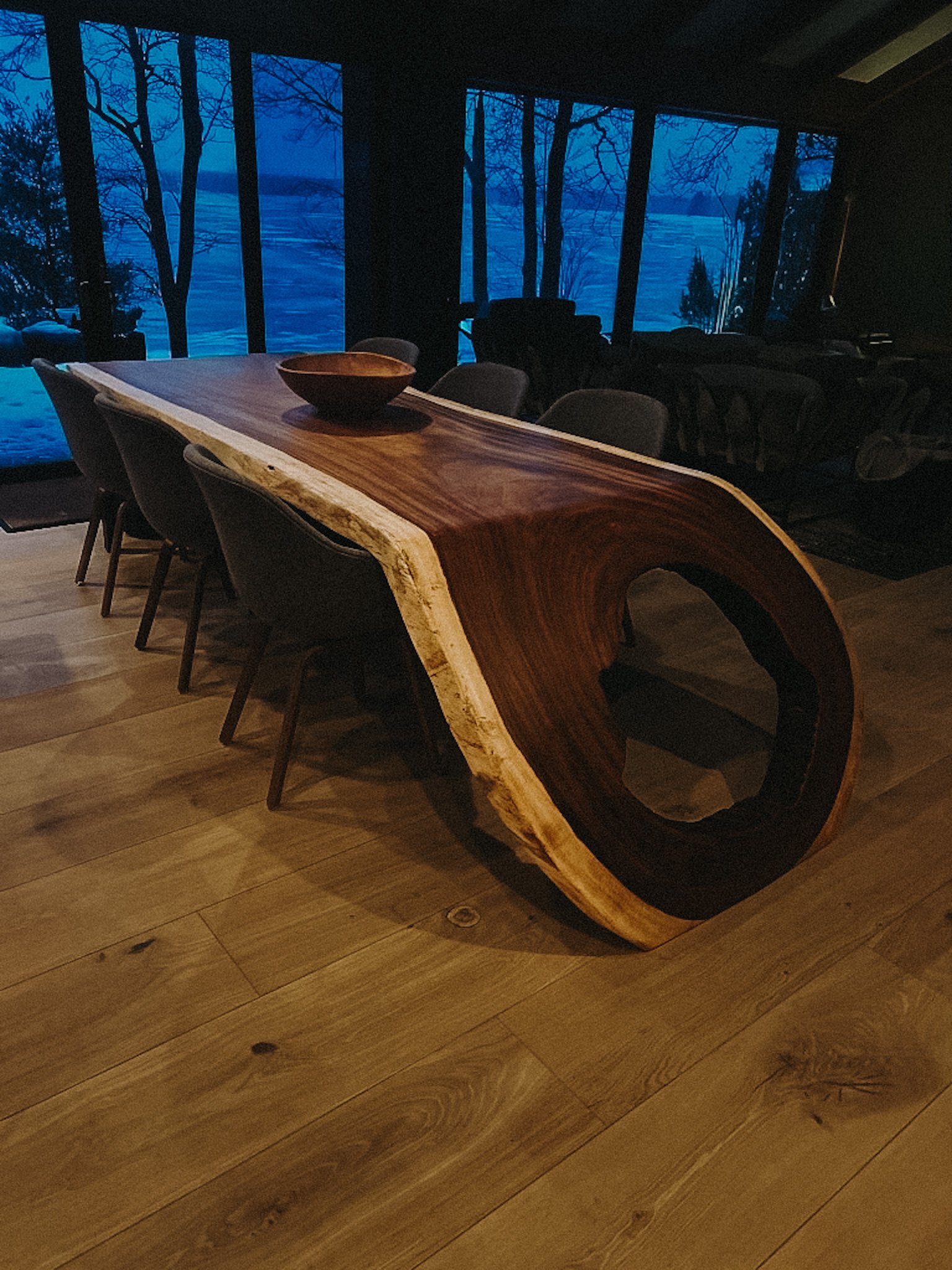
Custom Dining Tables
Custom Dining Tables: Everything You Need to Know Before You Buy
Most dining tables are forgotten the moment they're assembled. You know the ones. Flat-pack furniture. Uniform grain printed on MDF. A finish that scratches after two Thanksgivings and can't be fixed — only replaced.
If you've started researching custom live edge dining tables, you already sense there's a better way.
Here's what this guide covers:
- What makes live edge tables fundamentally different from anything in a showroom
- The specific wood species — and the reason its grain stops people cold
- How the custom sizing process actually works (including slab selection from across the country)
- What "heirloom quality" means in real, measurable terms
- And what a custom live edge dining table actually costs
What Makes a Live Edge Dining Table Different
A live edge table keeps the natural edge of the slab intact. No uniform factory profile. The edge follows the actual contour of the tree — dips, curves, and all.
That's not just an aesthetic choice. It's a declaration. This slab came from a specific tree, in a specific place, and there is no other one exactly like it on the planet. That's the thing retail can never give you — singularity.
Every live edge piece also carries visible grain character: growth rings compressed over decades, natural figuring, subtle color variation from heartwood to sapwood. It reads as alive in a way that manufactured wood panels simply don't. And when it's built right? It's not furniture. It's the center of the room.
The Wood Behind the Table — Why Donnie Uses Guanacaste
Not all hardwoods are equal. And not all hardwoods make for a great live edge table. Guanacaste is different.
It's imported primarily from Costa Rica, where it grows unusually fast. That rapid growth is exactly what produces its dramatic, varied grain — the growth rings compress and expand in a way that creates intense visual complexity. The result looks like it took centuries.
The default color reads like walnut: a rich, warm brown with depth. But it takes tint beautifully in either direction. Want to push it darker — closer to ebony? Done. Pull it lighter for a Scandinavian or whitewashed aesthetic? Also done. That versatility means a Guanacaste table can anchor a modern industrial kitchen just as naturally as a warm, traditional dining room.
The grain varies enough that no two slabs look alike. Each one is its own thing.
Built for Your Space, Not a Showroom Floor
Custom sizing isn't just about picking a length off a dropdown menu. The process starts with a real question: how many people do you actually want to seat? Not the number on the label — the number that includes holiday overflow, card nights, Sunday dinners with the extended family.
From there, the table is engineered to fit — including where the legs land. If you want end seating, the legs have to be placed to allow it. These decisions happen at the design stage, before a single cut is made.
For local clients in Nashville, slab selection happens in person at the shop. For clients buying remotely, Donnie wets the slab before walking you through it on FaceTime — revealing the true grain exactly as it will look under a finish. No guessing. No surprises when it shows up. Some buyers have planned trips to Nashville specifically to hand-select their slab.
The Finish That Makes It a Family Heirloom
The slabs run 1.5 to 3 inches thick — solid wood, all the way through. Not veneer. Not engineered panels with a hardwood face. The same grain you see on the surface runs all the way to the bottom.
What that means in practice: a scratch is never a death sentence. No matter how deep it goes, you're still in the same wood. The surface can be refinished — fully restored — after years of hard family use.
The finish used on dining tables is food-safe, built for daily use, and if it needs refreshing after years of service, there's a "refresh" spray product that restores the finish shine. That's not a product feature. That's a commitment to longevity.
How Much Does a Custom Live Edge Dining Table Cost?
A custom live edge dining table from Sawdust and Whiskey starts at around $4,000. That's the entry point for a piece built to your exact dimensions, from a hand-selected slab, with a food-safe finish rated for decades of use — and the ability to be fully refinished if it ever needs it.
Compare that to a mid-range retail table at $800–$1,500. That table has a fixed size, a factory finish you can't restore, and no grain character to speak of. It'll look dated in ten years. The $4,000 table gets handed down.
On the upper end, the most expensive table built came in at $100,000 — a commission requiring exceptional slabs, large-scale fabrication, and craftsmanship that became the centerpiece of a luxury property. That range — $4,000 to $100,000 — tells you something important: this isn't a rigid product line. It's a process. Your table lives somewhere in that spectrum, defined entirely by what you need and what the right slab turns out to be.
Ready to See Your Slab?
The best way to understand what a custom live edge dining table can look like in your space is to see the wood. If you're in Nashville, come to the shop. Walk the slabs. Ask Donnie to wet one and show you what it looks like under finish.
If you're anywhere else in the country, that same conversation happens over FaceTime — same result, different zip code. Every table starts with a conversation. Reach out and tell Donnie what you're imagining to find out what's possible.
Frequently Asked Questions
How long does it take to build a custom live edge dining table?
Lead time varies depending on the scope of the project and current shop schedule, but most custom dining tables take several weeks from slab selection to delivery. Remote clients complete slab selection via FaceTime, which keeps the process moving without requiring a trip. Ask Donnie for a current timeline estimate when you reach out.
Can I order a custom live edge dining table if I don't live in Nashville?
Yes. Sawdust and Whiskey builds and ships nationwide. Remote clients go through the same design process as local ones — including a live FaceTime slab walkthrough where Donnie wets the wood to show the true grain before you commit. Many clients have received tables without ever visiting the shop in person.
What's the difference between a live edge table and a regular wood dining table?
A standard dining table uses milled lumber with uniform, routed edges. A live edge table preserves the natural contour of the original slab — including the organic curves and character of the tree's outer edge. The result is one-of-a-kind: no two live edge slabs are identical, and the visual depth of a properly finished live edge piece is something that manufactured furniture can't replicate.
Frequently Asked Questions about Custom Dining Tables
1. How long does it take to build a custom dining table?
Most custom dining tables take 6 to 12 weeks from the time you finalize your design and slab selection. Lead time depends on the complexity of the piece, the current shop schedule, and how quickly decisions get made on your end. If you have a hard deadline — a holiday, a housewarming, a move-in date — mention it upfront so we can plan accordingly.
2. Can I see the actual slab my table will be made from before I commit?
Yes, and we strongly encourage it. Local clients visit the shop and walk the yard in person. Remote clients go through a live FaceTime walkthrough where we wet the slab so you can see exactly how the grain will look under finish. You're not buying a catalog photo — you're selecting a specific piece of wood.
3. What does "live edge" actually mean?
Live edge means the natural outer edge of the tree slab is preserved rather than cut into a straight, uniform line. That edge follows the original contour of the tree — curves, dips, and organic variation included. Every live edge piece is one of a kind because no two trees grow the same way.
4. What wood species do you use for dining tables?
Our primary species for dining tables is Guanacaste, imported from Costa Rica. It offers dramatic grain character, exceptional durability, and the flexibility to be finished light or dark depending on your interior. We work with other species as well — ask us what's currently available in the yard.
5. Can I customize the size of my table?
Absolutely. Custom sizing is the whole point. We build to your exact dimensions — length, width, and height — based on your space and how many people you want to seat. We don't have fixed sizes. Your room and your lifestyle drive the spec.
6. What's the typical price range for a custom live edge dining table?
Our dining tables start at around $4,000 and go up from there depending on slab selection, size, base design, and finish. The most complex commissions can reach well into five figures. Most clients land somewhere in the $4,000 to $15,000 range. We'll give you an honest estimate once we understand what you're looking for.
7. Why does a custom table cost so much more than a retail table?
A retail table is manufactured at scale using engineered wood, printed grain, and factory finishes that can't be repaired. A custom table is built from a single solid slab, sized to your space, finished to last decades, and refinishable if it ever needs it. You're not paying more for the same thing — you're paying for a fundamentally different object.
8. Do you offer financing or payment plans?
We typically require a deposit to begin work, with the balance due upon completion. Payment plan availability varies — reach out and we'll discuss what works for your situation.
9. How do I measure my dining room to figure out the right table size?
A good rule of thumb is to leave at least 36 inches between the table edge and the wall or any furniture on all sides — this gives comfortable walking and seating clearance. Measure your room, subtract that clearance on each side, and that gives you your maximum table footprint. We'll help you work through it during the design conversation.
10. How many people can a live edge dining table seat?
That depends entirely on the size we build. A 72-inch table comfortably seats 6. An 84- to 96-inch table seats 8. Go to 120 inches and you're seating 10 to 12. We design around your seating goal, not the other way around.
11. Can I choose where the legs are positioned?
Yes, and this is an important decision. Leg placement affects whether you can seat people at the ends of the table. If end seating matters to you, we position the legs accordingly. We work through that during the design phase before any cuts are made.
12. What base and leg styles are available?
We offer a range of base options including trestle, pedestal, hairpin, and custom steel or wood configurations. The right base depends on the slab, your seating needs, and the aesthetic of your space. We'll show you options that complement the specific slab you select.
13. Is the wood solid all the way through, or is it a veneer?
Solid all the way through. Our slabs run 1.5 to 3 inches thick — the same grain you see on the surface goes straight to the bottom. There is no veneer, no engineered core, no MDF substrate. That's what makes the table refinishable and genuinely heirloom-grade.
14. What finish do you use, and is it food-safe?
Yes, the finish we use on dining tables is food-safe and built for the demands of daily family use. It's one of the most durable wood finishes available. It protects against spills, heat, and everyday wear without requiring constant maintenance.
15. What happens if my table gets scratched or damaged?
Because the slab is solid wood all the way through, scratches don't penetrate into a different substrate — you're still in the same material. Surface damage can be sanded out and the table refinished to look new. That's something you simply cannot do with a veneer or engineered wood table.
16. Can the finish be refreshed over time without a full refinish?
Yes. We offer a refresh spray product that restores the sheen of the finish after years of use. It's a straightforward process that extends the life of the finish and keeps the table looking its best without requiring a full sand-and-recoat.
17. Do you ship nationwide?
Yes. We build and ship to clients all over the country. Remote clients go through the same design and slab selection process as local ones — including the FaceTime walkthrough. White-glove delivery options are available for long-distance orders.
18. How is the table packaged for shipping?
Tables are wrapped, padded, and crated to protect the slab and base during transit. We've shipped to clients coast to coast and take the packaging seriously — a table this substantial deserves to arrive in perfect condition.
19. Do I need to assemble it when it arrives?
Minimal assembly is typically required — usually attaching the base to the top. We provide clear instructions, and the process is straightforward. For local clients, we offer delivery and setup at the shop's discretion.
20. Can I visit the shop to see the work in person?
Yes, and we encourage it. Visiting the shop gives you a real sense of the material, the craftsmanship, and the scale of the slabs. Some clients travel from out of state specifically to hand-select their slab. Contact us to schedule a visit.
21. What is Guanacaste wood, and where does it come from?
Guanacaste is a hardwood native to Central America, imported primarily from Costa Rica. It's known for its fast growth rate, which produces exceptionally dramatic and varied grain. The color reads similar to walnut — warm, rich brown — but it accepts tint in either direction, making it one of the most versatile species we work with.
22. Can the table be finished lighter or darker than the natural wood color?
Yes. Guanacaste takes tint beautifully in both directions. We can push it toward a deep ebony finish or pull it back toward a lighter, Scandinavian-style tone. We'll walk you through options based on your space and aesthetic during the design conversation.
23. Will my table look exactly like the ones I see in photos?
No — and that's the point. Every slab is unique. Photos give you a sense of grain character, color range, and scale, but the specific slab we select for your table will have its own figure, edge profile, and personality. That's the nature of working with natural wood.
24. What if I don't like the slabs available right now?
New slabs come in regularly. If what's currently in the yard doesn't feel right, we can wait for new inventory or source specifically for your project. We'd rather take the time to find the right slab than rush you into something that doesn't excite you.
25. Can you match a specific wood tone to my existing furniture or flooring?
We can get close. Bring photos, paint swatches, or flooring samples to the conversation — digital or in person. We'll work with what you have to select a slab and finish that complements your space. An exact match isn't always possible with natural wood, but a beautiful complement almost always is.
26. Do live edge tables work in modern or contemporary interiors?
Absolutely. The organic edge of a live edge slab pairs exceptionally well with clean, minimal interiors — it provides the warmth and natural character that modern spaces often lack. The key is the right base. A simple steel or hairpin leg keeps the look current and the slab front and center.
27. Are there natural voids or cracks in the wood? Is that normal?
Yes, and they're part of the character. Natural voids and checking are features of genuine hardwood slabs — they tell the story of the tree. We stabilize any voids that need it and fill them with clear or tinted epoxy if desired. Some clients love them left open. It's your call.
28. Can you fill voids with colored epoxy?
Yes. Epoxy fills are available in a range of colors — black and clear are the most popular. Some clients choose a contrasting color to make the void a design feature. We'll show you examples so you can decide what feels right for your slab.
29. How do I care for my live edge dining table day to day?
Wipe spills promptly with a damp cloth. Avoid harsh chemical cleaners or abrasive scrubbers. Use trivets for hot dishes. For routine cleaning, a mild soap and water solution is all you need. The finish does the heavy lifting — your job is to keep it clean, not to baby it.
30. Should I use placemats and coasters on a live edge table?
We recommend them as a good habit, not a requirement. The finish is rated for daily family use and handles moderate heat and moisture well. That said, consistently using coasters and trivets will extend the life of the finish and keep the table looking its best over the long haul.
31. Will the wood move or warp over time?
All solid wood moves with changes in humidity — that's normal and expected. We build with that in mind: the base attachment method allows for natural movement without stressing the slab. Keeping your home at a reasonably stable humidity level (between 35% and 55%) is the best thing you can do for any solid wood furniture.
32. Do you make matching benches or chairs to go with the table?
Yes. Matching live edge benches are a popular complement to our dining tables. Custom chairs are also available. Having matching pieces built from the same slab family creates a cohesive look that's impossible to replicate with off-the-shelf seating.
33. Can I order a bench from the same slab as my table?
In some cases, yes — depending on the width and length of the slab. When a slab is large enough to yield both a table and bench pieces, we can work through that together. It's worth asking during slab selection.
34. Do you build other furniture besides dining tables?
Yes. We build a range of live edge pieces including coffee tables, console tables, desks, kitchen islands, and more. If you have a project in mind, reach out and we'll tell you whether it's something we can take on.
35. Can I order a custom live edge kitchen island?
Yes. Kitchen islands follow a similar process to dining tables — custom dimensions, slab selection, finish, and base. There are additional considerations around plumbing cutouts or seating overhangs that we factor in during the design phase.
36. What if I want a table with two slabs joined together — a bookmatched table?
Bookmatched tables — where two slabs are cut from the same log and mirrored — are something we can discuss depending on slab availability. The result is a dramatic, symmetrical grain pattern that reads like a Rorschach across the table surface. Let us know if that's the look you're after.
37. How thick will my table be?
Our dining slabs typically run between 1.5 and 3 inches thick. The exact thickness depends on the slab selected. Thicker slabs feel more substantial and have a more commanding presence in the room — it's one of the first things people notice in person.
38. What's the standard dining table height?
Standard dining height is 30 inches. We build to that by default unless you specify otherwise. Counter-height (36 inches) and bar-height (42 inches) versions are also available if that fits your space better.
39. Do you offer counter-height or bar-height tables?
Yes. If you're working with counter-height stools or a bar-style setup, we can adjust the base height accordingly. Just let us know your seating style during the design conversation.
40. Is a deposit required to start the project?
Yes. We require a deposit to begin work and hold your slab. The deposit amount and payment structure will be outlined when we put together your project quote. The balance is typically due upon completion before delivery.
41. What if I need to make a change after the project has started?
Minor changes early in the process are usually manageable. Major changes after work has begun — particularly after the slab has been cut — may affect cost and timeline. The best way to avoid that is to work through all decisions carefully before we break ground. We take time upfront for exactly that reason.
42. Can I cancel my order after placing a deposit?
Deposits are generally non-refundable once work has begun, as materials are committed and shop time is allocated. If something comes up before work starts, reach out immediately — we'll do our best to work with you on it.
43. Do you work with interior designers and contractors?
Yes, and we enjoy those collaborations. If you're an interior designer specifying furniture for a client, or a contractor working on a custom build, we're happy to work within your project's timeline and coordinate directly with your team.
44. Can I see examples of past work before I decide?
Absolutely. We have a portfolio of completed pieces you can view, and clients are welcome to visit the shop to see finished and in-progress work in person. Seeing the scale and finish quality in real life goes a long way toward understanding what you're investing in.
45. What makes Sawdust & Whiskey different from other custom furniture makers?
The combination of material, process, and transparency sets us apart. We specialize in Guanacaste specifically because of what it does under finish. We show you the actual slab — wetted — before you commit. And we build with the expectation that these tables outlast the people who buy them. That's not standard in this industry.
46. Is this table really something I can pass down to my kids?
That's exactly the intent. Solid slab, food-safe finish, refinishable surface, durable base — everything about how these tables are built is oriented toward multi-generational use. The only retail furniture that gets handed down is the kind that was built to last. This is built to last.
47. What if my table gets damaged during shipping?
We document the condition of every piece before it leaves the shop. If damage occurs in transit, we work with the carrier to file a claim and make it right. In the rare case where a piece arrives damaged, contact us immediately with photos and we'll determine the appropriate resolution.
48. Can I see what my slab looks like under finish before it's finished?
Yes — that's exactly what the wetting process does. Water temporarily mimics the effect of a clear finish, showing you the true color and grain depth of the slab before any finish is applied. Remote clients see this on FaceTime. Local clients see it in person at the shop. There are no surprises.
49. How do I get started?
Reach out and start a conversation. Tell us about your space, how many people you want to seat, and any aesthetic direction you have in mind. From there we'll discuss slab options, sizing, base styles, and give you a realistic estimate. There's no pressure — just a conversation about what's possible.
50. Is a custom live edge table really worth it compared to buying retail?
That depends on what you're buying furniture for. If you want something functional, inexpensive, and replaceable in a few years — retail works fine. If you want a table that becomes a fixture of your family's life, that your kids will grow up around and eventually inherit, that gets more beautiful as it ages — then yes, it's worth it. Most clients who go custom never go back to buying retail furniture. The difference isn't subtle once you've experienced it.


Sawdust & Whiskey is a family-run workshop based in Nashville, TN—built on craftsmanship, trust, and the belief that the best pieces, like a well-aged whiskey, take time.

Meet the Team
-
![A man in glasses holding a glass of whiskey, standing in front of a dark wooden background, wearing a brown vest over a black shirt.]()
Donny Fallgatter
Founder & Craftsman
-
![A woman with long dark hair smiling and holding a glass of wine indoors.]()
Casey Fallgatter
Founder & Social Media Manager
-
![A man wearing a green beanie and a black hoodie, standing with arms crossed in a warmly lit wooden interior.]()
Ted Burnley
Shop Foreman
-
![A woman with long dark hair wearing a red knit beanie, a cream turtleneck sweater, and a plaid jacket smiling in a cozy, rustic indoor setting.]()
McKenna Hydrick
Marketing & Brand Creative