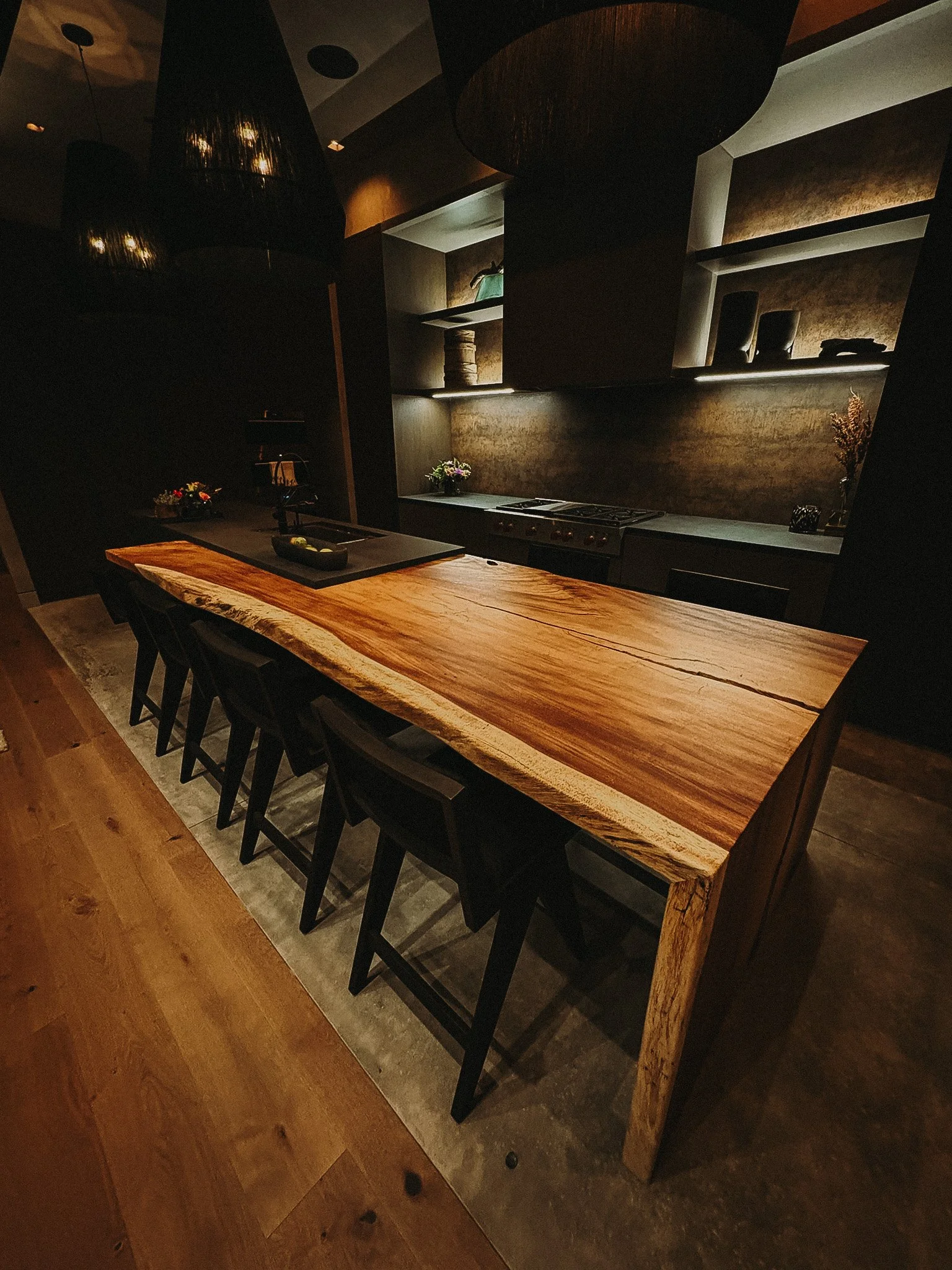
Custom Wood Countertops
Custom Wood Countertops: The Complete Guide to Slabs, Species, and What to Expect
You already know a wood countertop is different from granite or quartz. You can feel it the moment you walk into a kitchen that has one. It's warmer. More alive. It looks like something someone actually made — not something that came off a factory line.
But here's what most guides don't tell you: not all custom wood countertops are created equal. The species, the finish, the thickness, the process — every detail shapes what you end up with.
This guide covers all of it. You'll learn what goes into a truly custom wood countertop, which wood types work best and why, how the craftsmanship process actually works, and what you should expect to pay for something built right.
What Are Custom Wood Countertops?
A custom wood countertop is exactly what it sounds like — a countertop cut, finished, and sized to fit your specific kitchen or space.
Here's the thing: that word "custom" gets thrown around loosely. At a big box store, "custom" might mean you pick a standard size from a catalog. True custom means a craftsman sizes the piece to your exact measurements — down to the fraction of an inch.
At Sawdust & Whiskey, that's not a marketing phrase. It's the process. Donnie has sized countertops to 1/8 of an inch to accommodate a specific cabinet handle overhang. That kind of precision doesn't exist at retail.
Custom wood countertops also differ from mass-produced options in thickness. Most store-bought wood countertops top out at 1.5 inches. A properly built slab countertop can run 2 to 3 inches thick — a substantial difference you notice immediately, both visually and underhand.
Types of Wood Used (and What Each One Does for You)
Wood species get a lot of attention. But here's what actually matters: the right wood for your countertop depends on how you use your kitchen — not just how you want it to look.
Walnut is a go-to for kitchens that need to feel refined. Its deep, chocolatey grain reads as luxurious without being loud. It holds up well under daily use and takes an oil wax finish beautifully, which means you can touch it up yourself at home without calling anyone.
White oak is harder and more neutral. If your kitchen skews lighter — white cabinets, natural stone, linen tones — oak gives you warmth without competing. It's also a strong candidate for spray finishes because its tight grain takes the coating evenly.
Maple is one of the densest domestic hardwoods available. If your countertop needs to work hard — a prep surface near the sink, a kitchen island that gets daily abuse — maple holds up without complaint.
The truth is, species selection at Sawdust & Whiskey starts with your color and grain preference. But from there, Donnie matches the wood to the right finish, which is where durability actually comes from.
The Craftsmanship Process
A custom wood countertop isn't just cut and delivered. There's a specific sequence that separates a piece that lasts decades from one that fails in a few years.
Here's what Donnie's process looks like:
Step 1 — Precision measuring. Every countertop starts with exact dimensions. For local clients, Donnie retrieves sink and cooktop templates directly from their home. For out-of-area clients, manufacturers include paper templates with appliances — those get mailed in. Either way, the cutouts are accurate. No guessing, no adjustments after the fact.
Step 2 — Penetrating epoxy. Before any finish goes on, Donnie applies a penetrating epoxy to the wood. This gets sanded back down after it cures. The result isn't a surface coating — it's embedded hardness built into the wood itself. He uses a hardness tester to verify the surface meets durability standards before anything leaves the shop. That step alone separates this from what most people think of as a "finished" countertop.
Step 3 — Finish selection. Two options exist, each with a real tradeoff.
- Spray finish is the most durable option available. It requires a professional spray booth — not something a DIYer or competitor without the equipment can replicate. The surface is harder and more resistant to daily kitchen use. The only catch: touch-ups require returning to the shop.
- Oil wax finish is slightly less durable but owner-serviceable. If you get a scratch or want to refresh the surface, you can do it yourself at home. It still prevents water rings under normal use — the concern most people have about wood countertops is handled at the finishing stage, not by avoiding wood altogether.
Both finishes are food safe.
Step 4 — Cutouts and final fitting. Sink, cooktop, and outlet cutouts are handled in-shop with manufacturer templates. For local clients, Donnie offers on-site installation and recommends having a plumber present for sink connections.
The result? A countertop sized to your exact space, hardened from the inside out, and finished to match your lifestyle.
What Does a Custom Wood Countertop Cost?
Here's where most articles hedge. They say "it depends" and leave you with nothing.
The reality: a custom wood countertop from Sawdust & Whiskey starts around $3,000 and runs to $10,000–$17,000 for larger or more complex builds.
That might feel like a wide range. It is — because the variables are real. Size, species, edge profile, finish type, cutout count, and whether installation is included all factor in.
But here's a more useful way to think about it: the price reflects what's inside the piece. You're paying for penetrating epoxy that's been sanded back into the wood. You're paying for spray booth infrastructure that doesn't exist in someone's garage. You're paying for precision sizing to 1/8 of an inch. You're paying for a piece that can be refinished and repaired — often in place, without removal — rather than replaced when it shows wear.
Granite can be cut to size too. But granite can't be 3 inches thick. It can't be touched up at home with a tin of oil wax. And it doesn't get better-looking with age.
A wood countertop built right is a 20-year decision, not a 5-year one. That changes the math entirely.
Is a Custom Wood Countertop Right for You?
The honest answer: it depends on what you're building toward.
If you want the least expensive surface that functions, wood isn't it. There are cheaper materials that do the job.
But if you're renovating a kitchen you plan to stay in — or building a lodge, a vacation home, or a commercial property that needs to feel premium — a custom wood slab countertop holds its value in a way that laminate and synthetic stone don't.
A few things that make this a clear yes:
- You want precision. Your space has irregular dimensions, a specific overhang, or a cutout that needs to match manufacturer specs exactly. This is routine work here.
- You want repairability. Most surface materials are finished when they're scratched. Wood can come back. That's a meaningful difference over the life of a kitchen.
- You want something permanent. Not permanent like "can't be moved" — permanent like "still looks right in 15 years."
Bottom line: the right buyer isn't looking for a countertop. They're looking for the last countertop they'll ever need.
Ready to See What's Possible?
Every piece Donnie builds starts with a conversation about your space, your wood preferences, and how you use your kitchen. There's no catalog. No standard sizes. No guessing.
If you're ready to talk through your project, contact Sawdust & Whiskey for a custom project estimate — or browse his countertop work to see what a custom wood slab looks like when it's done right.
Wood Countertop Frequently Asked Questions
Are wood countertops a good idea?
For many homeowners, yes. Wood countertops offer warmth, character, and repairability that materials like laminate and engineered stone cannot match. When properly built and finished, a wood countertop can serve as a durable work surface for decades.
What are the pros and cons of wood countertops?
Wood countertops provide natural beauty, repairability, and a unique appearance. They can also be refinished if damaged. The tradeoff is that they require some maintenance and should not be treated the same way as synthetic materials.
Are wood countertops durable?
Yes. A properly constructed hardwood countertop can withstand daily kitchen use for many years. Durability depends on wood species, finish quality, and routine care.
How long do wood countertops last?
A well-built wood countertop can last 20 years or more. Many hardwood countertops remain in service for generations because they can be repaired and refinished rather than replaced.
Are wood countertops worth the money?
Many homeowners believe they are because of their longevity, appearance, and ability to be restored over time. Unlike many countertop materials, wood often improves in character as it ages.
Do wood countertops increase home value?
While no countertop guarantees a specific return on investment, custom wood countertops are often viewed as a premium design feature that can make a home more memorable to buyers.
Why do people choose wood countertops instead of quartz?
Many people prefer wood because it feels warmer, looks more natural, and can be repaired if damaged. Quartz offers lower maintenance, while wood offers greater character and repairability.
Why do people choose wood countertops instead of granite?
Wood provides a softer, more inviting aesthetic and is often easier to repair. Granite offers exceptional hardness, but chips and cracks can be more difficult and expensive to address.
What is the most durable wood for countertops?
Maple, white oak, and walnut are among the most popular countertop woods because they balance hardness, stability, and appearance.
What is the best wood for kitchen countertops?
The best wood depends on your goals. Walnut is known for rich color, white oak for durability and versatility, and maple for exceptional hardness and performance.
Is walnut good for countertops?
Yes. Walnut is one of the most popular countertop species thanks to its rich color, attractive grain, and ability to age beautifully over time.
Is white oak good for countertops?
Yes. White oak is durable, stable, and versatile. Its lighter appearance makes it a favorite for modern and transitional kitchen designs.
Is maple good for countertops?
Maple is one of the hardest domestic hardwoods available and performs exceptionally well in kitchens that see heavy daily use.
What wood lasts longest as a countertop?
Longevity depends on construction and maintenance as much as species. Properly finished walnut, white oak, and maple countertops can all last for decades.
Can wood countertops get wet?
Yes. Properly finished wood countertops are designed to handle normal kitchen moisture. Standing water should still be wiped up promptly.
Do wood countertops warp?
Quality wood countertops built from kiln-dried material are designed to remain stable. Proper installation and environmental conditions help minimize movement.
Do wood countertops crack?
Wood naturally expands and contracts with seasonal humidity changes. Proper construction techniques significantly reduce the likelihood of problematic cracking.
Do wood countertops stain easily?
Modern finishes provide excellent protection against most household spills. Prompt cleanup of acidic substances helps preserve the finish.
Do wood countertops get water rings?
A properly finished countertop should resist water rings under normal use. Finish quality plays a significant role in long-term performance.
Can wood countertops mold?
Like any natural material, wood can develop mold if subjected to prolonged moisture and poor ventilation. Proper finishing and routine care greatly reduce this risk.
Are wood countertops hard to maintain?
No. Most wood countertops require little more than routine cleaning and occasional maintenance depending on the finish selected.
How often do wood countertops need maintenance?
Oil wax finishes typically require periodic refreshes every one to two years. Professional spray finishes may go many years before needing attention.
Can wood countertops be refinished?
Yes. One of the greatest advantages of wood countertops is that scratches, wear, and surface damage can often be repaired through refinishing.
What happens if a wood countertop gets scratched?
Most scratches can be repaired. Depending on the finish, minor damage may be addressed with spot repairs rather than full replacement.
Can I cut directly on a wood countertop?
While possible, it is not recommended. A cutting board protects both the countertop finish and your knives.
Can I put hot pans on a wood countertop?
No. Trivets and heat pads should always be used to prevent finish damage and potential wood movement caused by extreme heat.
How do I clean wood countertops?
Warm water, mild soap, and a soft cloth are typically all that is needed for routine cleaning.
Are wood countertops sanitary?
Yes. Properly maintained wood surfaces have been used in kitchens and food preparation environments for generations.
What is the difference between butcher block and wood countertops?
Butcher block countertops are made from multiple pieces of wood laminated together. Custom wood countertops may be butcher block, plank construction, or solid slab designs.
Can wood countertops be custom sized?
Yes. One of the primary advantages of custom countertops is the ability to fit exact dimensions, unusual layouts, and unique design requirements.
Can I get a live edge wood countertop?
Yes. Live edge countertops preserve the natural contour of the tree and are particularly popular for islands, bars, and statement pieces.
How thick should a wood countertop be?
Most custom countertops range from 1.75 to 3 inches thick depending on the desired appearance and application.
How much do custom wood countertops cost?
Custom wood countertops typically start around $3,000 and increase based on size, species, finish, cutouts, and installation requirements.
Why are custom wood countertops expensive?
Custom countertops involve premium materials, precision fabrication, finishing systems, and significant craftsmanship that are not present in mass-produced alternatives.
How much does a walnut countertop cost?
Pricing varies by size and design, but walnut countertops generally command premium pricing because of material demand and visual appeal.
How much does a wood kitchen island cost?
Custom islands vary widely in size, but most fall within the same pricing range as custom countertop projects, often between $3,000 and $17,000.
Are wood countertops cheaper than quartz?
At the custom level, wood and quartz are often comparable in price. The long-term value proposition differs because wood can typically be repaired and refinished.
Are wood countertops cheaper than granite?
Pricing varies by project, but custom wood countertops often compete directly with premium stone installations.
Can wood countertops be repaired?
Yes. Repairability is one of the strongest advantages of wood over many competing countertop materials.
Can wood countertops be moved and reinstalled?
In many cases, yes. Unlike stone, wood countertops can often be removed and reinstalled if handled properly.
How long does it take to build a custom wood countertop?
Most custom countertop projects require several weeks from deposit to delivery, depending on complexity and material availability.


Sawdust & Whiskey is a family-run workshop based in Nashville, TN—built on craftsmanship, trust, and the belief that the best pieces, like a well-aged whiskey, take time.

Meet the Team
-
![A man in glasses holding a glass of whiskey, standing in front of a dark wooden background, wearing a brown vest over a black shirt.]()
Donny Fallgatter
Founder & Craftsman
-
![A woman with long dark hair smiling and holding a glass of wine indoors.]()
Casey Fallgatter
Founder & Social Media Manager
-
![A man wearing a green beanie and a black hoodie, standing with arms crossed in a warmly lit wooden interior.]()
Ted Burnley
Shop Foreman
-
![A woman with long dark hair wearing a red knit beanie, a cream turtleneck sweater, and a plaid jacket smiling in a cozy, rustic indoor setting.]()
McKenna Hydrick
Marketing & Brand Creative